2026-1-13
Release Date : 2026.01
Format :PDF+ExceL
Pages :
Contact :Client@sigmaintell.com
Request Free Brief ReportAs the automotive industry undergoes a profound transformation toward intelligence and connectivity, ADAS SoCs have emerged as the "digital brain" of smart vehicles. Their evolution directly dictates the pace of autonomous driving deployment and the dynamics of the industrial competitive landscape.
According to the latest research by Sigmaintell, the global penetration rate of L2-level smart driving reached 50% in 2025, a significant leap from 32% in 2022. Global ADAS SoC shipments hit approximately 70 million units in 2025, representing a year-on-year increase of 7%. This figure is projected to exceed 100 million units by 2032, implying that nearly every new vehicle leaving the factory will be equipped with at least one dedicated SoC.
Based on current industry dynamics, Sigmaintell identifies three key trends:
1) Regulatory Catalyst: With L3 regulations poised for imminent implementation, 2026 will mark a golden era for high-performance ADAS SoCs.
2) Market Reshuffle: The competitive landscape is undergoing a seismic shift. While Mobileye faces mounting pressure, players like NVIDIA, Qualcomm, and China’s Horizon Robotics are actively reshaping market leadership.
3) Technology Pivot: The focus of the tech race has shifted from "peak theoretical (TOPS)" to "effective compute" and "power efficiency." Centralized computing (Cockpit-Driving Integration) SoCs have become the critical path for cost reduction, while 5nm and below advanced process nodes serve as both the cornerstone of performance leaps and the primary source of supply chain risk.
The above content is excerpted from Sigmaintell's"ADAS Industry Research Brief (2026)."
This brief systematically maps out the industry across core dimensions, including:
• Market Trends: Detailing the catalytic effect of L3 regulation on market demand; forecasting global ADAS SoC shipment and penetration trends from 2025 to 2032; and identifying the core growth drivers for each stage.
• Competitive Landscape: Analyzing the competitive strategies and strengths of key players such as Mobileye, NVIDIA, Qualcomm, and Horizon Robotics; interpreting the logic behind the shifting market leadership; and mapping the formation of diversified competition tiers.
• Technology Roadmap: Deep-diving into the core value of "effective compute" and "power efficiency"; analyzing the technical path and application prospects of Cockpit-Driving Integration SoCs; and outlining the development demands and supply chain risks associated with advanced process nodes.
• OEMs & Supply Chain: Exploring the feasibility and trends of automakers developing SoCs in-house; analyzing how economies of scale and full-stack integration capabilities determine the success or failure of self-development; providing targeted strategic references for industry stakeholders.
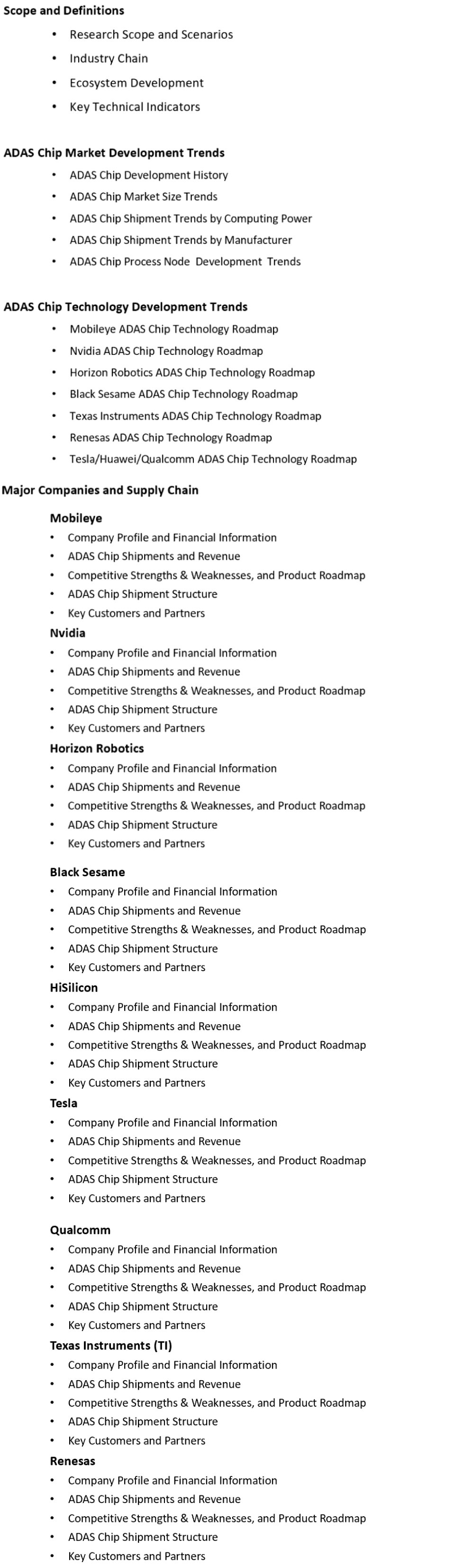
Contents: